

















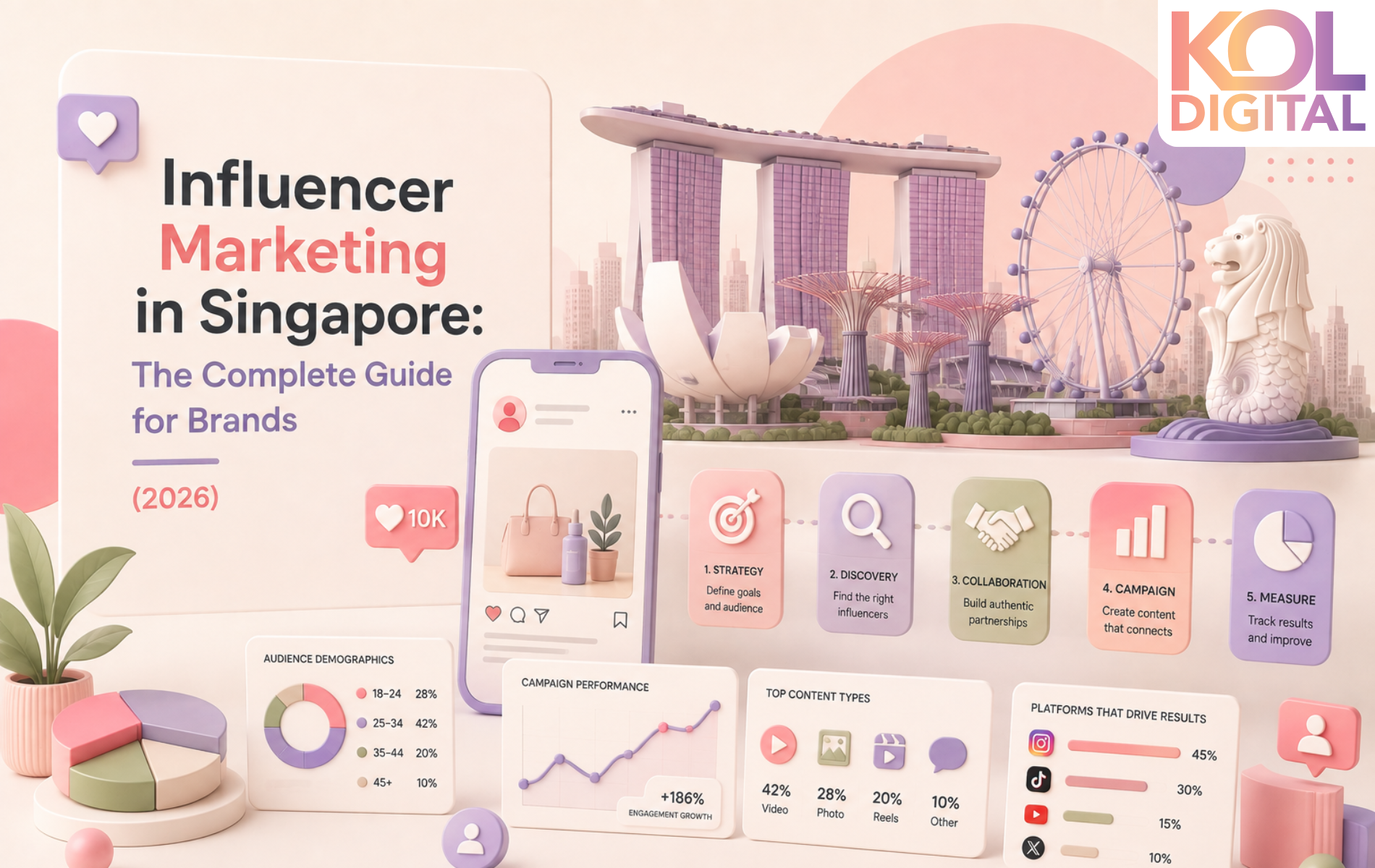
Singapore’s influencer ad spend climbed 12.9% to US$119 million in 2025, and it’s still growing. If your brand is still waiting to “test” influencer marketing, the market has already moved ahead. Social media usage in Singapore is almost universal. There are now 5.33 million social media user identities, which is 90.6% of the population. That means almost every customer you want to reach is already on these platforms.
Even more important, 67% of users trust influencers more than traditional ads.
So if your competitors are already working with influencers and you’re not, they’re not just getting reach; they’re shaping customer decisions before you even enter the conversation.
The industry itself is growing fast. Influencer marketing in Singapore reached SGD 285 million in 2025, with 24% year-on-year growth, making it one of the fastest-growing channels in Southeast Asia.
At KOL Digital Singapore, we’ve delivered over 500 influencer marketing campaigns across a wide range of industries. Through this experience, we’ve seen what works, what doesn’t, and where brands usually go wrong.
In this write-up, we’ll walk you through everything you need to know:
- which platforms actually drive real conversions
- how influencer campaigns are structured in Singapore
- how to choose the right influencer tier based on your budget
- and how to avoid the common mistakes that waste budget without results
Here we begin.
What is Influencer Marketing, And Why It Works in Singapore
Influencer marketing is straightforward: a brand pays a creator/ influencer to produce content that features or recommends a product, and that creator’s audience sees a recommendation from someone they already follow and trust.
What makes it different from a banner ad or TV commercial is the relationship. When someone you follow for skincare tips recommends a serum, it feels like advice from a friend, not a sales pitch. That distinction drives the entire channel’s effectiveness.
The collaboration structures range from one-off paid posts to long-term brand ambassador deals.
| Brand pays influencer → influencer creates content → audience sees trusted recommendation |
Common formats include:
- Gifting (sending products in exchange for organic reviews),
- paid posts,
- Instagram Reels,
- TikTok videos,
- YouTube integrations,
- live shopping streams
All of these fall under the influencer marketing umbrella.
Why Singapore Consumers Respond to Influencer Marketing
Singapore has a few unique factors that make influencer marketing especially effective.
- First, people spend a lot of time online. On average, Singaporeans spend 17 hours per week on social media and use 7.4 platforms every month. That’s more than two hours a day across multiple apps.
- Second, content style matters. Singapore audiences show 3.7x higher engagement with authentic, unpolished content compared to highly produced ads. In simple terms, overly polished content gets ignored; real content performs better.
- Third, people don’t just scroll; they buy. 68% of users have made purchases directly through social platforms. That’s much higher than the regional average of 51%.
- Finally, Singapore is multilingual and multicultural. Content that mixes languages (like English + Chinese or Malay) often performs better than English-only content because it feels more relatable.
Influencer Advertising Market snapshot: 2026
Statista shows that the influencer advertising market in Singapore is projected to grow at a CAGR of 10.87% from 2024 to 2029, reaching a market volume of US$177 million by 2029.
78% of Singapore companies now have dedicated influencer marketing line items in their annual budgets, up from 63% in 2023. This isn’t experimental spending anymore.
Influencer marketing has become a core channel.
Types of Influencers in Singapore
Not all influencers are built the same. The tier you choose has a direct impact on your campaign cost, reach, engagement, and conversion rate. Here’s how the Singapore market breaks down.
Quick Comparison Table
| Tier | Followers | Avg. engagement (SG) | Best for |
| Nano | 1K–10K | 3–5% | Local awareness, seeding |
| Micro | 10K–100K | 2–4% | Conversions, niche campaigns |
| Macro | 100K–500K | 1–3% | Brand launches, awareness |
| Mega / Celebrity | 500K+ | 0.5–1.5% | Mass market, repositioning |
Campaign requirements and content formats vary across influencer tiers and platforms.
Nano Influencers (1,000 – 10,000 Followers)
Nano influencers have small but very tight communities. Their followers often feel like they personally know them, which builds strong trust.
Best for:
- product seeding campaigns,
- hyper-local F&B launches,
- community building for new brands.
A new café opening in Tanjong Pagar, for example, could seed 30 nano influencers in the area and generate authentic reviews within days at a fraction of macro influencer cost.
Micro Influencers (10,000 – 100,000 Followers)
This is where most brands should start. Micro influencers balance reach + trust + cost efficiency. Best for targeted campaigns, conversion-focused goals.
They usually focus on a niche:
- Beauty
- Fitness
- Parenting
- Food
For most SMEs, 8–12 micro influencers often drive stronger engagement and conversions than relying on a single macro influencer.
Our micro-influencer network covers verified creators across every major industry vertical in Singapore.
Macro Influencers (100,000 – 500,000 Followers)
Macro influencers (lifestyle, fashion, tech) give you scale. They create polished content and have a wider reach.
Best for:
- product launches where reach matters,
- brand repositioning,
- and campaigns that need both credibility and scale.
Mega Influencers & Celebrities (500,000+ Followers)
This tier includes traditional celebrities who’ve built large social followings. The reach is massive, but so is the cost.
These partnerships make most sense for:
- mass-market products,
- national-scale launches,
- or when a brand needs the halo effect of a well-known name.
For celebrity influencer partnerships, explore our celebrity influencer marketing services.
Key Social Media Platforms for Influencer Marketing in Singapore
Platform choice is one of the most consequential decisions in campaign planning. The same content, the same influencer, and the same budget will produce completely different results depending on where it lives.
Platform Decision Matrix
| Your Goal | Primary Platform | Secondary |
| Beauty/skincare launch | Xiaohongshu, TikTok | |
| F&B new outlet | TikTok | |
| Tech product review | YouTube | |
| Chinese-speaking audience | Xiaohongshu | |
| Parenting/family products | ||
| B2B / professional services | YouTube | |
| Gaming peripherals | YouTube | TikTok |
| Mass market awareness | TikTok + Instagram |
Here are the details.
Instagram – Still the Foundation
Instagram is used by 87% of brands in their Singapore influencer strategy and is the primary platform for 52% of brands. It remains the dominant channel for beauty, fashion, lifestyle, and F&B.
The format mix matters:
- Reels drive discovery and reach,
- Stories drive direct engagement and link clicks,
- and feed posts carry the longest shelf life for brand perception.
A well-structured Instagram campaign typically uses all three.
Best industries: beauty, fashion, F&B, luxury, travel, parenting.
Our beauty influencer network primarily operates on Instagram, where skincare and makeup content perform strongest.
TikTok – Fastest-growing, Highest Discovery
TikTok had 3.80 million users aged 18 and above in Singapore in late 2025, reaching 75.4% of all adults aged 18 and above. TikTok is used by 76% of brands in Singapore influencer campaigns and is the primary platform for 28%.
The algorithm’s unique strength is that content quality beats follower count. For instance, a creator with 15,000 followers can get a million views on a great video. That makes TikTok valuable at every influencer tier.
TikTok Shop integration in Singapore has also changed the game for e-commerce brands. Viewers can buy directly from a video or live stream without leaving the app, shortening the conversion funnel dramatically.
Best industries: F&B, beauty, gaming, fashion, lifestyle products, anything that benefits from demonstration.
YouTube – Long-form Trust and Product Reviews
YouTube is the best platform when your product needs a proper explanation.
It works well for content like:
- Tech reviews
- Fitness programs
- Cooking tutorials
- Gaming products
If people need to understand how a product works before buying, YouTube gives that space.
In Singapore, many users go to YouTube to research before making high-value or important purchases. They don’t just want to see the product; they want to see it used, tested, and explained.
For gaming product launches, our gaming influencer network uses YouTube heavily because detailed reviews and demonstrations help drive real conversions.
Xiaohongshu (RED) – the Fastest-growing Sleeper Platform
Xiaohongshu is a platform many Singapore brands are still overlooking, but it’s growing fast. It already has 800,000+ active users in Singapore, which is about 14% of the population. Projections show this could reach 1.2 to 1.5 million users by 2026.
Among Chinese Singaporeans, the impact is even bigger. The platform has around 42% penetration, and since Chinese Singaporeans make up 74.5% of the population, this represents a very large and valuable audience.
For brands in:
- Beauty
- Fashion
- F&B
- Lifestyle
Xiaohongshu offers a strong first-mover advantage, especially since competition is still lower than that of Instagram.
What makes this platform different is how people use it. Users actively search for reviews before buying, not just scroll for content. Also, content lasts longer here. A single strong post can continue driving traffic and sales for months.
Facebook – Still Relevant for 35+ Audiences
Facebook’s reach in Singapore remains substantial, particularly for the 35+ demographic. It’s the right platform for parenting products, home services, financial products, and community-driven campaigns.
Mommy influencers often drive significant engagement through Facebook groups where the community interaction is tighter than on Instagram. For brands targeting parents or older consumers, Facebook should be part of the mix.
KOL vs Influencer Marketing in Singapore – What’s the Difference?
This distinction between KOL and influencer marketing trips up a lot of brands, especially those coming from Western markets.
What KOL Actually Means
KOL stands for Key Opinion Leader (关键意见领袖 in Chinese).
A KOL is not just someone popular; they are recognised experts in a specific field. Their influence comes from knowledge and credibility, not just follower numbers.
For example:
- A fitness influencer shares workout content and has a lifestyle audience
- On the other hand, a fitness KOL is a certified trainer or sports expert, and people trust their advice because of their professional background
So the difference is clear:
- Influencers = popularity and relatability
- KOLs = expertise and authority
In Singapore, the term “KOL” is widely used because of the country’s strong Chinese business influence and its connection to Southeast Asian markets.
When to Use KOLs vs Lifestyle Influencers
Use KOLs when trust and expertise are a must:
- Financial products
- Healthcare and wellness
- Technical B2B services
- Professional services
- Skincare science
- Legal services
Use lifestyle influencers when the decision is driven by lifestyle and relatability:
- Fashion
- Travel
- Food
- Home décor
- General consumer products
The Hybrid Approach (Most Common Today)
Many campaigns now combine both.
For example:
- Beauty creators who are trained aestheticians
- Fitness influencers with professional coaching certifications
These creators offer both:
- Authority (like a KOL)
- Reach and engagement (like an influencer)
That’s why they perform very well in today’s market.
If your brand needs both credibility and reach, you can explore our KOL marketing services to find the right mix for your campaigns.
How to Build an Influencer Marketing Strategy in Singapore
Most campaigns that fail do so because of strategy gaps, not execution problems. Here’s the framework that works.
Step 1: Define Your Campaign Objective Clearly
Before you look at a single influencer profile, write down exactly what you want this campaign to achieve.
- Not “increase brand awareness” – that’s too vague to measure.
- Instead: “Generate 500 tracked sales of Product X in 6 weeks” or “Grow Instagram following from 8,000 to 20,000 over the campaign period.”
Your objective determines everything downstream: which platform, which tier, which content format, and which KPIs to track.
Step 2: Know Your Target Audience
Who are you actually trying to reach? Build out a clear demographic and psychographic picture. Age range, income bracket, location within Singapore (East vs West vs CBD), interests, values, lifestyle.
Then verify that the influencers you’re considering actually reach that audience. Ask for audience insight screenshots. An influencer with 80% Singapore-based followers in the 25–34 age bracket is worth far more for most local campaigns than one with mostly overseas followers.
Step 3: Choose the Right Tier and Platform
Match your campaign objective and audience to the right influencer tier. The decision is simpler than most brands think:
- Awareness campaign with a mid-range budget → 2–3 macro influencers on Instagram
- Conversion-focused campaign → 8–12 micro influencers with strong niche authority
- Testing a new market → nano influencer seeding campaign across 20–30 creators
- Mass market launch → multi-platform approach combining TikTok reach with Instagram credibility
Browse our influencer categories to find verified creators by niche and platform.
Step 4: Set Your Budget Realistically
A common mistake is allocating the entire budget to influencer fees and leaving nothing for amplification or production. A better split looks like this:
Budget allocation framework:
- 70% → influencer fees
- 20% → content usage rights and paid amplification (boosting top-performing posts)
- 10% → campaign management and reporting
Don’t try to run one mega influencer campaign when 10 micro campaigns at the same budget would produce better ROI. Smaller-scale diversification consistently outperforms concentration at the top.
Step 5: Brief Your Influencer Properly
A vague brief is the single biggest cause of off-brand content. Your brief should cover:
- brand background (one paragraph),
- key messages (no more than three),
- must-include and must-avoid elements,
- content format requirements,
- posting timeline,
- and disclosure requirements.
What you should not do: write a script. Creators know their audience better than you do. Give them the guardrails, then let them execute in their authentic voice.
Step 6: Track Results and Measure ROI
Every campaign should have pre-agreed KPIs tied to the objective:
| Campaign objective | Primary KPIs | Tracking method |
| Awareness | Reach, impressions, follower growth | Platform analytics |
| Engagement | Saves, shares, comments | Platform analytics |
| Traffic | Clicks, sessions, time on site | UTM links, GA4 |
| Conversion | Sales, sign-ups, app downloads | Promo codes, tracked URLs |
| ROI calculation: (Revenue generated − Campaign cost) ÷ Campaign cost × 100 |
Strong influencer campaigns can generate significant returns when creators, platforms, and campaign goals are aligned properly.
Disclosure and Compliance in Singapore
Disclosure and compliance in Singapore are important and should not be ignored.
- Influencer posts must clearly show #ad, #sponsored, or Paid Partnership in a visible place, not hidden among hashtags, and this applies to both paid and gifted collaborations.
- Advertising is regulated by the Advertising Standards Authority of Singapore (ASAS) under the SCAP (Singapore Code of Advertising Practice), and for financial-related campaigns, MAS guidelines (introduced in 2025, effective 2026) also apply.
- Both the brand and the influencer share responsibility for proper disclosure, so it cannot be left only to the creator.
If these rules are not followed, it can lead to content removal, account issues, fines, and damage to brand reputation. The best approach is to include disclosure requirements in every influencer brief and make it a standard part of your campaign from the start.
Why Work With an Influencer Marketing Agency in Singapore
Working with an influencer marketing agency in Singapore is easy cause the DIY challenge is tough to handle. You can run influencer campaigns yourself, but it takes a lot more work than most brands expect.
In reality, you’ll need to:
- Find influencers across different platforms
- Check for fake followers (this needs tools and experience)
- Negotiate pricing and contracts
- Create and manage briefs
- Review and approve content
- Coordinate posting timelines
- Track performance across platforms
- Handle last-minute issues (like an influencer going silent before launch)
Agencies that properly vet influencers reject up to 60% of applicants due to low-quality followers, poor engagement, or weak past performance. When you do this yourself, you’re taking on that risk without the data or systems to do it properly.
If you’re just starting with influencer marketing on a smaller scale, DIY can work. But once campaigns get bigger, the time, effort, and risk usually cost more than hiring an agency.
What an Agency Actually Handles
A good influencer marketing agency manages the full campaign from start to finish.
This includes:
- Finding and vetting influencers (checking followers, engagement, brand safety)
- Planning campaigns based on your business goals
- Creating briefs and onboarding influencers
- Managing content approvals
- Scheduling and coordinating posts
- Tracking performance in real time
- Providing clear reports with ROI
- Handling issues (like replacing influencers if problems arise)
At KOL Digital SG, campaigns follow a clear 4–6 week process, from strategy planning to final reporting, so you always know what’s happening.
What to Look for When Choosing an Influencer Marketing Agency in Singapore
Not all agencies deliver the same quality. Before you choose one, check a few key things:
- Influencer network: Do they have verified creators across industries and platforms? Ask to see examples.
- Real case studies: Look for actual numbers (reach, engagement, conversions), not vague claims.
- Transparent reporting: Will you see real data, or just a summary? Good agencies provide clear dashboards.
- Local expertise: Singapore has a unique market (multilingual audience, platform behaviour). The agency should understand this well.
Red flags to avoid:
- Agencies promising “viral results”
- No real case studies
- No access to influencer profiles before signing.
Common Influencer Marketing Mistakes Brands Make in Singapore
Most campaigns fail not because of budget, but because of poor planning and execution. Small mistakes in selection or strategy can easily reduce campaign effectiveness.
Mistake 1: Choosing Influencers Based on Follower Count Alone
This is the most common mistake and the most costly. A creator with 200,000 followers and a 0.8% engagement rate is less valuable than one with 40,000 followers and a 6% engagement rate for most campaigns.
| The engagement rate formula: (Total likes + comments) ÷ Total followers × 100. |
In Singapore, 3%+ is good, and 6%+ is excellent. Anything below 1% on an account with large follower numbers is a red flag for purchased followers.
Most decent influencer platforms include engagement rate data. Always look at it before follower count.
Mistake 2: No Clear Brief or KPIs
Vague briefs produce off-brand content. If you don’t tell the creator exactly what key message to convey, what must never appear in the content, and what a successful post looks like, you’ll get generic content that doesn’t move your business metrics.
A strong brief includes:
- brand background,
- campaign objective,
- key message (one primary, one or two secondary),
- visual and tonal guidelines,
- mandatory disclosures,
- posting timeline,
- and what the brand will measure as success.
Mistake 3: Ignoring Disclosure Requirements
This can lead to serious issues like content removal or regulatory warnings. In Singapore, disclosure is mandatory, and it must always be included in contracts and briefs from the start, not treated as optional.
Mistake 4: One-off Campaigns Instead of Sustained Partnerships
Single posts rarely build strong results. Audiences need repeated exposure to trust a brand. Long-term collaborations perform better and are also more cost-efficient since onboarding and setup costs are reused over time.
Wrapping Up
Influencer marketing in Singapore is no longer experimental. It has become a core marketing channel across industries like beauty, F&B, tech, and financial services. The way brands plan and run campaigns now directly impacts results and ROI.
Here’s what to remember from this guide:
- Influencer tier matters more than follower count: match the tier to your goal and budget. Micro influencers with 3–7% engagement often outperform macro influencers in conversion-focused campaigns.
- Platform choice is strategic: Instagram leads overall, TikTok drives discovery, YouTube supports high-consideration purchases, and Xiaohongshu is growing fast for Chinese-Singaporean audiences.
- KOLs and influencers serve different purposes: KOLs bring authority and expertise, while influencers drive relatability and lifestyle appeal.
- Measurement must be planned from the start: UTM links, promo codes, and KPIs are important for tracking real performance.
- Compliance is mandatory: ASAS and IMDA rules require clear disclosure, and both brand and influencer share responsibility.
- Long-term partnerships work better: repeated collaborations build trust, improve content quality, and reduce overall costs compared to one-off campaigns.
Ready to start your influencer campaign in Singapore?
Get a free consultation from the KOL Digital team, or explore our influencer network to find the right creators for your brand.
FAQs
You can search hashtags like #sgfoodie, #singaporebeauty, or #sglifestyle on Instagram and TikTok to find creators in your niche. You can also use platforms like Partipost, Gushcloud, and Kobe to search influencer lists in Singapore. Another option is working with an agency like KOL Digital SG, which already has verified influencers and helps you avoid fake followers.
To spot fake followers, look at comments; real accounts have normal, natural comments, not only emojis or repeated spam words. Compare follower count with engagement using tools like HypeAuditor or Social Blade to see if the numbers match. Many agencies reject around 60% of influencers because good engagement usually needs at least 85% real, active followers.
Yes, small brands can easily start with nano and micro influencers. Many brands choose nano influencers because 39% of companies prefer them for more real and authentic engagement at a lower cost.
Most influencer campaigns take about 4–6 weeks from start to finish. This includes finding influencers, contracts, content creation, approvals, and posting. Faster campaigns are possible, but they usually cost more and may reduce content quality, so planning 6–8 weeks ahead is better. |