


















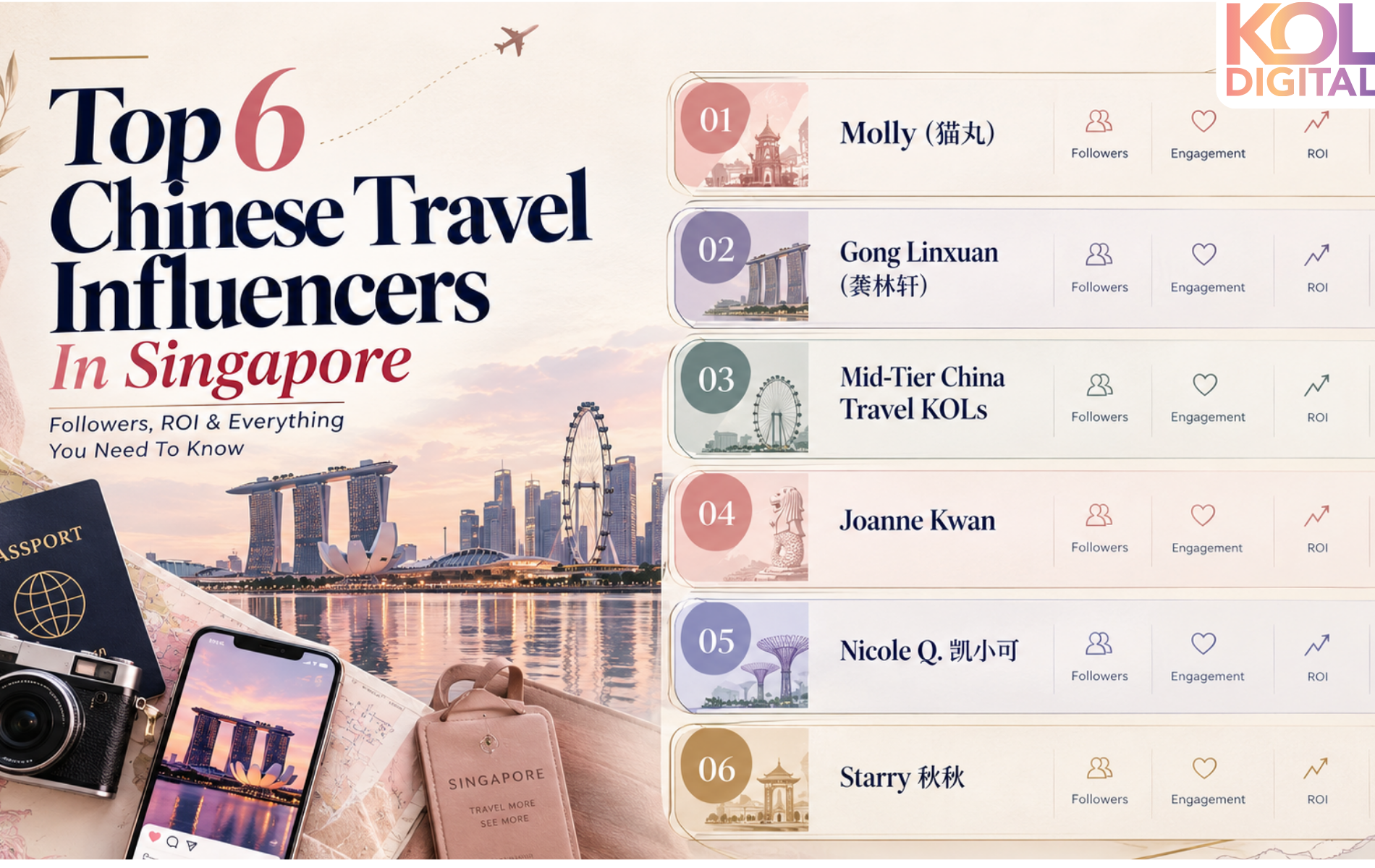
Chinese travel influencers can help Singapore brands reach Chinese-speaking travellers before, during, and after their trip. But “Chinese travel influencers” does not describe one type of creator or audience.
A brand may be targeting mainland Chinese tourists planning a Singapore trip, Chinese-speaking Singapore residents, or Chinese visitors already in Singapore, and each group can behave differently across platforms such as Xiaohongshu, Douyin, and Weibo.
This guide looks at the different China-based and Singapore-based creators brands can work with, where they fit in the travel journey, and how to choose the right one.
It also covers travel influencers in Singapore and how KOL Digital can support these campaigns.
What are Chinese Travel Influencers?
Chinese travel influencers are creators who shape how Chinese-speaking audiences discover, compare, and experience destinations.
They include –
- China-based travel KOLs,
- Singapore-based bilingual creators,
- travel KOCs,
- food-and-travel creators,
- family travel accounts,
- and luxury lifestyle creators.
For a Singapore brand, the useful question is not simply “How many followers does this creator have?” It is “Who follows them, what do those people use their content for, and where are they in the travel journey?”
That matters because a creator who influences a mainland Chinese traveller planning a Singapore holiday has a different role from a Singapore creator recommending a new hotel to a local audience.
Singapore’s tourism market is large enough to justify this level of targeting. The Singapore Tourism Board reported 16.9 million international visitor arrivals in 2025, including 3.1 million visitors from Mainland China, making China Singapore’s largest source market that year.
The Three Chinese-Speaking Travel Audiences Singapore Brands Target
Singapore brands can divide the opportunity into three groups:
- Mainland Chinese travellers planning a trip,
- Chinese-speaking residents in Singapore,
- and Chinese visitors already in Singapore.
Each group needs a slightly different creator and content approach.
| Audience | Main platforms | Suitable creator |
| Mainland Chinese travellers | Xiaohongshu, Douyin (Chinese TikTok), Weibo | China-based KOL/KOC |
| Chinese-speaking Singapore residents | Xiaohongshu, Instagram | Singapore-based bilingual creator |
| Chinese visitors in Singapore | Xiaohongshu and China-based platforms | Singapore travel KOL/KOC |
Here are the details.
Mainland Chinese Travellers Planning a Singapore Trip
This is the clearest audience for China-based Chinese travel influencers. Xiaohongshu, Douyin and Weibo can help brands reach mainland Chinese travellers while they are researching hotels, attractions, food, shopping and itineraries.
The timing matters because travel research often starts months before the trip. On Xiaohongshu in particular, travellers can use the platform to search for destination ideas, practical recommendations and places to visit before building their itinerary.
A hotel may therefore need to appear in a traveller’s shortlist before that person ever reaches Singapore. A detailed Mandarin travel post with useful information can be more valuable for this audience than content designed only to create a short burst of awareness.
Chinese-Speaking Singapore Residents
This audience is different. They already live in Singapore, understand the local market, and may use Mandarin content when deciding where to eat, stay, shop, or travel next.
Singapore-based bilingual creators can work well here because they understand local references. They can also connect Singapore audiences with nearby destinations such as Malaysia, Thailand, and Indonesia.
Chinese Visitors Already in Singapore
There is also an in-destination opportunity. A traveller who is already in Singapore may search for a restaurant near Marina Bay, a shopping area, a family attraction, or something to do that evening. This is where location-specific Xiaohongshu content can be useful.
Singapore Tourism Board’s current work with Chinese travel platforms also shows that visitor information is moving beyond simple destination promotion toward more personalised, on-the-ground experiences. In April 2026, STB partnered with Mafengwo on Mandarin and English visitor guides at Sentosa and Mandai.
Xiaohongshu: Why It Matters for Chinese Travel Influencers
Xiaohongshu is an important platform for Chinese travel influencer marketing because Chinese travellers use it to research where to go, stay, and eat before a trip. It is not just a platform for scrolling through content.
For Singapore brands, this means a travel influencer can create a detailed Mandarin post that helps a traveller decide:
- Where to stay: hotel reviews, room recommendations and facilities
- Where to go: attractions, neighbourhoods and hidden spots
- What to eat: restaurants, dishes and food recommendations
- How to plan: transport, timings, costs and itinerary ideas
A strong Xiaohongshu travel post should include:
- High-quality photos or short video
- Detailed Mandarin captions
- Specific recommendations based on first-hand experience
- Relevant Mandarin search terms and hashtags
- A location tag where appropriate
The key advantage is discovery during the research stage. Instead of simply seeing a hotel in a feed, a traveller can actively search for Singapore travel recommendations and find a creator’s experience while deciding what to book.
That makes Xiaohongshu travel influencers particularly useful for Singapore hotels, attractions, restaurants and tourism brands that want to influence travel decisions before Chinese visitors arrive.
In May 2026, the Singapore Tourism Board also signed an MOU with Xiaohongshu to better understand Chinese travellers’ consumer journeys, further highlighting the platform’s importance to Singapore tourism.
For comparison:
| Platform | Strongest role in a travel campaign |
| Xiaohongshu | Research, recommendations and trip planning |
| Douyin | Short-form discovery and reach |
| Awareness and conversation | |
| Singapore-based bilingual audiences |
China-Based Chinese Travel Influencers Singapore Brands Can Consider
For Singapore tourism brands targeting mainland Chinese travellers, China-based Chinese travel influencers can help put hotels, attractions, restaurants and experiences in front of audiences already interested in travelling to Singapore.
Molly (猫力)
Molly, known as 猫力, is a long-established Chinese travel creator who became known for independent travel and aspirational destination content.
Her profile has appeared in major international coverage of China’s travel influencer market, including Jing Daily’s influential list of Chinese travel creators.
For a Singapore brand, the value is less about using an old follower number and more about her positioning. A creator with a strong travel identity can fit luxury hotels, premium experiences, and destination storytelling better than a general entertainment account.
Best fit: luxury hospitality, premium experiences, and destination campaigns.
Gong Linxuan (龚林轩)
Gong Linxuan is another creator identified by Jing Daily as a Chinese travel trend expert. His work also crosses into fashion and lifestyle, which makes him more relevant when travel is connected to premium brands, shopping, or culture.
His example shows why Singapore brands should not search only for accounts labelled “travel influencer”. A fashion-and-travel creator may be a better match for Orchard Road, luxury retail, or a high-end hotel than a general destination account.
Best fit: luxury, fashion, retail, and culture-led travel campaigns.
Mid-Tier China Travel KOLs
Singapore brands do not always need a celebrity creator. Mid-tier creators can give a campaign more room to focus on a specific audience or travel interest.
For example, one creator could focus on family travel, another on food, and another on hotel stays. Together, they can create several pieces of content around different reasons to visit Singapore.
For Singapore campaigns, useful creator segments include:
- 100K–500K followers: destination guides and focused travel audiences
- 50K–100K: niche travel, food, hotel, and lifestyle content
- 10K–50K: specialist or highly focused travel communities
So, the important point is not simply follower size. Before selecting a creator, check current followers, engagement, audience location, travel relevance, and recent Singapore-related content.
For cross-border campaigns, Singapore brands can also work with influencer marketing Singapore agencies that can handle Mandarin creator communication, China-platform requirements, and campaign coordination.
Singapore-Based Chinese Travel Influencers for Local Audience Reach
For Singapore brands targeting Chinese-speaking audiences in Singapore, local creators offer an important advantage: they understand Singapore’s culture and travel habits while creating content that feels natural to Chinese-speaking audiences.
Joanne Kwan
Joanne Kwan creates bilingual travel content across Instagram and Xiaohongshu, covering Asia-Pacific destinations and cultural experiences. As of January 2026, she has 68K+ Instagram followers and 45K+ Xiaohongshu followers.
Her bilingual presence makes her useful for campaigns that need to reach both English-speaking and Chinese-speaking audiences.
Best fit: Singapore hotels, regional airlines, Malaysia tourism, and Asia-Pacific travel campaigns.
Nicole.Q 妮小可
Nicole.Q creates Chinese-language content around Singapore food, lifestyle, travel, and places to explore. She has also been used in Xiaohongshu campaigns targeting audiences interested in Singapore’s local experiences, and her content includes detailed recommendations for restaurants and places around the city.
Best fit: restaurants, attractions, shopping, hotels, and local experiences.
Starry 秋秋
Starry 秋秋 is a Singapore-based Xiaohongshu creator known for sharing food, travel guides, and things to do in Singapore. Her recent content continues to focus on Singapore lifestyle and local experiences, including food and wellness-related discoveries.
Best fit: food tourism, attractions, events, and lifestyle experiences.
What to Check Before Choosing a Creator
Follower count alone is not enough. Singapore brands should check:
- Active Xiaohongshu presence
- Genuine Mandarin or bilingual content
- Singapore-based audience
- Recent Singapore or Malaysia travel content
- Engagement through saves, comments, and shares
- Relevant brand partnerships
- A clear travel or lifestyle niche
For local Chinese-Singaporean campaigns, the strongest creator is therefore not necessarily the biggest account. Local audience relevance, Chinese-language content, and genuine Singapore expertise matter more than follower count alone.
Which Chinese Travel Influencer is Right for Different Singapore Brands?
The best creator depends on what the brand sells and what the campaign needs the audience to do.
A luxury hotel, family attraction, and restaurant should not use the same creator profile just because all three want Chinese travellers.
| Singapore brand | Creator type to consider |
| Luxury hotel | Luxury travel KOL |
| Boutique hotel | Mid-tier travel creator or KOC |
| Restaurant | Food + travel creator |
| Attraction | Experience/travel creator |
| Luxury retail | Lifestyle + travel KOL |
| Family attraction | Family travel creator |
| Tourism board | Mix of KOLs and KOCs |
| Airline | Travel and lifestyle creator |
This approach also fits the direction of Singapore’s 2026 tourism marketing. STB and Scoot’s 2026 Singapore Superfans campaign used KOLs across China and other markets, then connected social engagement to a limited-time flight sale.
KOL vs KOC – The Conversion Difference for Chinese Travel Campaigns
KOLs (Key Opinion Leaders) are generally better when a Singapore brand needs broad awareness, while KOCs (Key Opinion Consumers) are useful when the campaign needs detailed reviews and personal recommendations.
Many campaigns can benefit from using both rather than choosing one side.
KOLs
KOLs usually have larger audiences and stronger name recognition. They can help a new hotel, attraction, or destination campaign get attention quickly.
Use them when the main goal is:
- Destination awareness
- Product launches
- Large campaigns
- Premium positioning
- Broad reach
KOCs
KOCs usually work closer to the review side of travel content. Their posts can focus on what the room is actually like, what a restaurant serves, whether an attraction suits children, or how long an itinerary takes.
Use them when the goal is:
- Detailed recommendations
- Product consideration
- Experience reviews
- Multiple content pieces
- Niche audiences
A practical campaign could therefore use one or two Chinese KOL travel influencers for awareness and several KOCs for deeper experience-led content.
How Singapore Brands Should Choose a Chinese Travel Influencer
Do not choose a Chinese travel influencer based on follower count alone. Start with the audience, then check the creator’s platform activity, travel niche, content quality, and past Singapore relevance.
Use this checklist before signing a creator:
- Audience location: Check whether followers are mainly in China, Singapore, or another market.
- Travel intent: Look at whether people save and discuss practical travel content.
- Content niche: Food, luxury, family, adventure, and shopping audiences behave differently.
- Platform strength: An inactive Xiaohongshu account should not count as Xiaohongshu expertise.
- Engagement quality: Check comments, saves, and shares rather than only likes.
- Singapore relevance: Previous Singapore content is useful, but it should also match the current campaign.
- Language quality: Mandarin content should sound natural, especially for Xiaohongshu.
- Audience authenticity: Review unusual follower spikes or engagement patterns.
- Brand fit: The product should make sense within the creator’s normal content.
- Content rights: Agree in writing where the brand can reuse the creator’s photos, videos, and posts.
How to Brief Chinese Travel Influencers for a Singapore Campaign
A good brief tells the creator what the campaign must achieve without turning the post into a scripted advertisement. Give the creator the facts, audience, and required deliverables, then leave room for a genuine travel experience.
A Singapore campaign brief should include:
- Campaign objective
- Target audience
- Product or destination
- Key facts
- Experience to feature
- Mandarin keywords
- Required locations or tags
- Content format
- Number of posts/videos
- Posting date
- Approval process
- Disclosure requirements
- Usage rights
- Tracking links or booking codes
There is also an important Singapore advertising requirement here. ASAS guidelines say sponsored social content should clearly disclose its commercial relationship and make that disclosure prominent and easy to see. The guidance specifically covers paid endorsements, sponsored content, and even complimentary experiences.
The Singapore Code of Advertising Practice also says advertising should be legal, honest, and truthful, while the Consumer Protection (Fair Trading) Act addresses misleading commercial representations.
So a creator should not present a paid hotel stay as though there were no commercial relationship.
Wrapping Up
Chinese travel influencers are not one interchangeable group. Singapore brands need to choose creators based on who they want to reach, where that audience is in the travel journey, and what action they want next.
For mainland Chinese travellers, China-based KOLs and KOCs can build interest before the trip. For Chinese-speaking audiences in Singapore, local bilingual creators can make the content more relevant.
With Xiaohongshu becoming an even more important part of Singapore’s China tourism strategy in 2026, creator selection, Mandarin content, and proper campaign tracking now matter more than simply buying reach.
Plan Your Chinese Travel Influencer Campaign with KOL Digital
KOL Digital manages both KOL and KOC campaigns with Mandarin-native creator briefing, Xiaohongshu expertise, and performance tracking from the initial brief through to bookings.
If you are looking for KOL travel marketing in Singapore to reach Chinese travellers, talk to KOL Digital about your next campaign.
Hire influencers for your campaign now.
FAQs
There is no single best creator for every Singapore campaign. China-based KOLs are useful for reaching mainland Chinese travellers, while Singapore-based Chinese-speaking creators can be better for local audiences and visitors already in Singapore. The right choice depends on audience location, travel niche, platform, and campaign objective.
The main platforms include Xiaohongshu, Douyin, and Weibo for mainland Chinese audiences. Xiaohongshu is particularly useful for travel research and recommendations. Singapore-based bilingual creators can also use Instagram to reach local Chinese-speaking and English-speaking audiences.
A China-based KOL usually helps a brand reach travellers before they leave China. A Singapore-based creator can speak from local experience and reach people already living in Singapore or visiting the city. The content can therefore be more location-specific.
Fees vary based on the creator’s audience, platform, content format, number of posts, exclusivity, usage rights, and campaign scope. Brands should request a current rate card and compare the actual deliverables rather than judging a quote from follower count alone.
Useful topics include hotels, restaurants, shopping, attractions, neighbourhoods, family activities, nightlife, itineraries and practical travel tips. The strongest content usually answers a real travel question rather than simply showing a brand logo. |